Research
The figures on this page are small calculations of the kind that appear in our papers. Each section lists a few representative publications.
Moiré materials
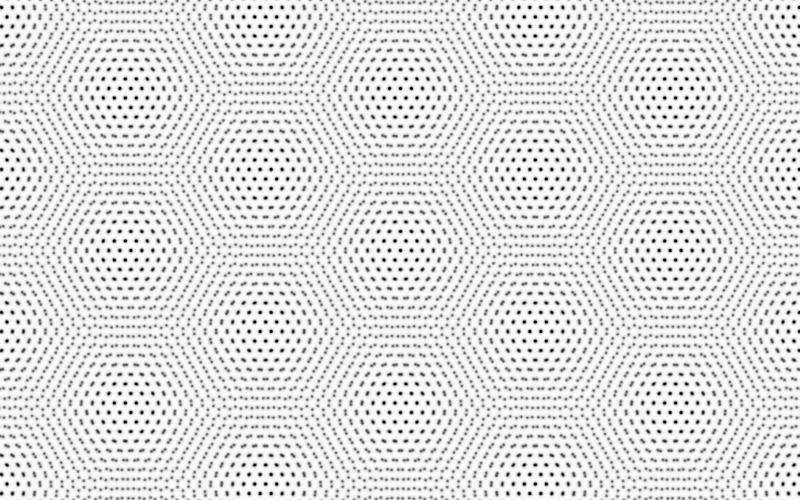
Two sheets of graphene stacked with a small twist form a moiré pattern whose period is many nanometers. Near the magic angle of about 1.1° the electronic bands become nearly flat, and interactions between electrons produce correlated insulators, superconductivity and magnetism.
We derived the single-particle and interacting Hamiltonians of twisted bilayer and trilayer graphene and showed that magic-angle graphene maps onto a topological heavy-fermion problem. We also study fractional Chern insulators in twisted transition-metal dichalcogenides and in rhombohedral graphene, and we built a database of two-dimensional materials that can be twisted into new moiré systems.
Representative papers
- Twisted bilayer graphene I. Matrix elements, approximations, perturbation theory, and a k·p two-band model
B. A. Bernevig, Z.-D. Song, N. Regnault, B. Lian
Phys. Rev. B 103, 205411 (2021) · arXiv - TSTG I: Single-Particle and Many-Body Hamiltonians and Hidden Non-local Symmetries of Trilayer Moiré Systems with and without Displacement Field
D. Călugăru, F. Xie, Z.-D. Song, B. Lian, N. Regnault, B. A. Bernevig
Phys. Rev. B 103, 195411 (2021) · arXiv - Magic-angle twisted bilayer graphene as a topological heavy fermion problem
Z.-D. Song, B. A. Bernevig
Phys. Rev. Lett. 129, 047601 (2022) · arXiv - 2D Theoretically Twistable Material Database
Y. Jiang, U. Petralanda, H. Pi, G. Skorupskii, Q. Xu, D. Călugăru, H. Hu, J. Xie, R. A. Mustaf, P. Höhn, et al.
Science 393, eadu1550 (2026) · arXiv
Flat bands and kagome materials
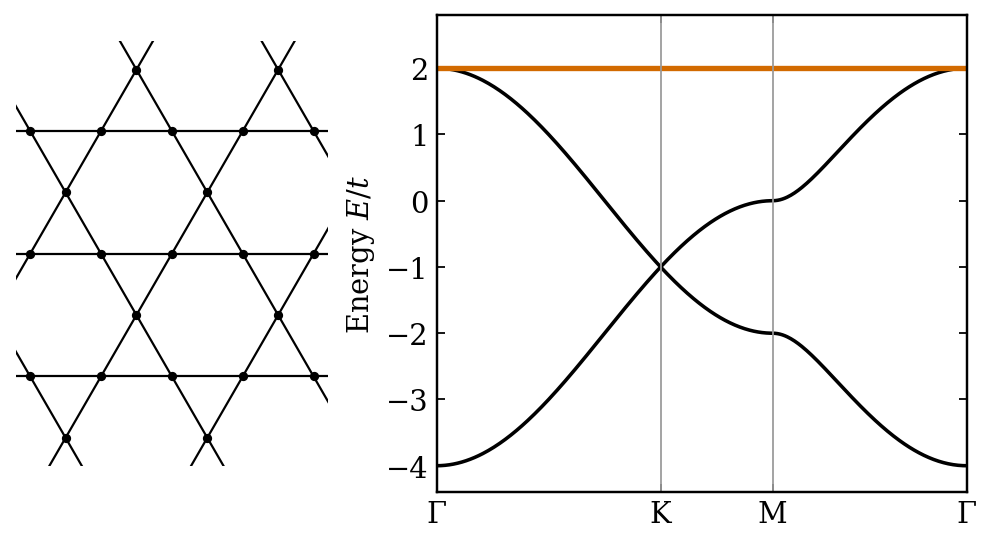
In a flat band the kinetic energy of the electrons is quenched, so interactions decide the ground state. Lattices such as the kagome lattice host flat bands because hopping paths interfere destructively.
We compiled a catalogue of flat-band materials among known crystals and study which correlated and topological phases these bands support.
Representative papers
- Catalogue of Flat-Band Stoichiometric Materials
N. Regnault, Y. Xu, M.-R. Li, D.-S. Ma, M. Jovanovic, A. Yazdani, S. S. P. Parkin, C. Felser, L. M. Schoop, N. P. Ong, et al.
Nature 603, 824 (2022) · arXiv - Spin-Orbit-Induced Topological Flat Bands in Line and Split Graphs of Bipartite Lattices
D.-S. Ma, Y. Xu, C. S. Chiu, N. Regnault, A. A. Houck, Z. Song, B. A. Bernevig
Phys. Rev. Lett. 125, 266403 (2020) · arXiv
Quantum geometry and superconductivity
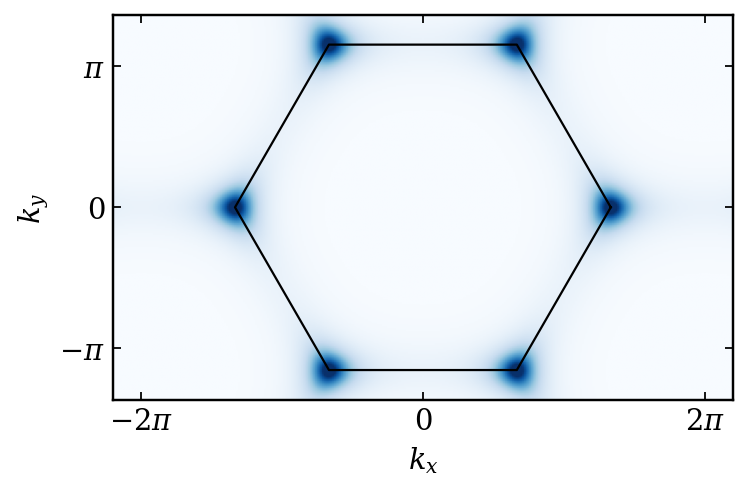
Bloch wavefunctions carry a geometry, measured by the Berry curvature and the quantum metric. This geometry controls responses that the band energies alone do not determine.
We showed that band topology sets a lower bound on the superfluid weight of a flat-band superconductor, with twisted bilayer graphene as the main example. We also study pairing and electron-phonon coupling in flat-band systems.
Representative papers
- Topology-Bounded Superfluid Weight In Twisted Bilayer Graphene
F. Xie, Z. Song, B. Lian, B. A. Bernevig
Phys. Rev. Lett. 124, 167002 (2020) · arXiv - Fragile topology and flat-band superconductivity in the strong-coupling regime
V. Peri, Z. Song, B. A. Bernevig, S. D. Huber
Phys. Rev. Lett. 126, 027002 (2021) · arXiv - Superfluid weight bounds from symmetry and quantum geometry in flat bands
J. Herzog-Arbeitman, V. Peri, F. Schindler, S. D. Huber, B. A. Bernevig
Phys. Rev. Lett. 128, 087002 (2022) · arXiv
Many-body physics and quantum scars
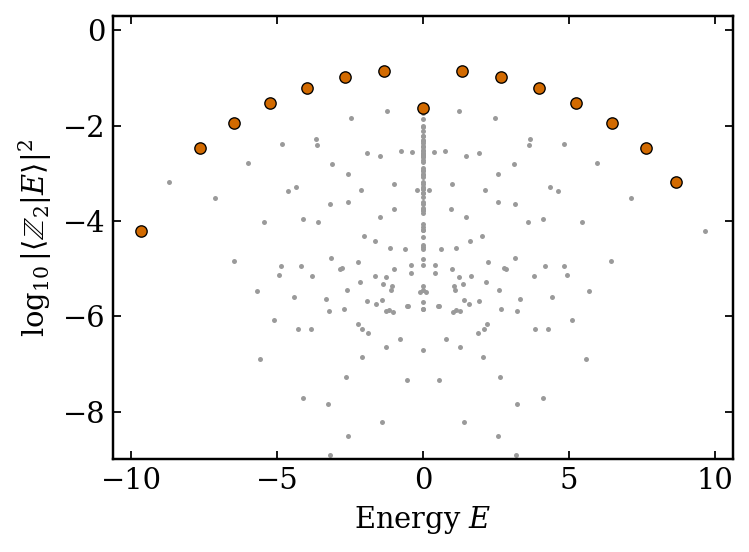
Generic interacting quantum systems thermalize, and their highly excited eigenstates look random. We found exact excited states with low entanglement in the AKLT spin chain. States of this kind are now called quantum many-body scars. They do not thermalize and produce long-lived oscillations.
The group also works on the fractional quantum Hall effect, where we related model wavefunctions to Jack polynomials, and on fractional Chern insulators in lattice models.
Representative papers
- Exact Excited States of Non-Integrable Models
S. Moudgalya, S. Rachel, B. A. Bernevig, N. Regnault
Phys. Rev. B 98, 235155 (2018) · arXiv - Model fractional quantum Hall states and Jack polynomials
B. A. Bernevig, F. D. M. Haldane
Phys. Rev. Lett. 100, 246802 (2008) · arXiv - Fractional Chern Insulator
N. Regnault, B. A. Bernevig
Phys. Rev. X 1, 021014 (2011) · arXiv
Topological phases of matter
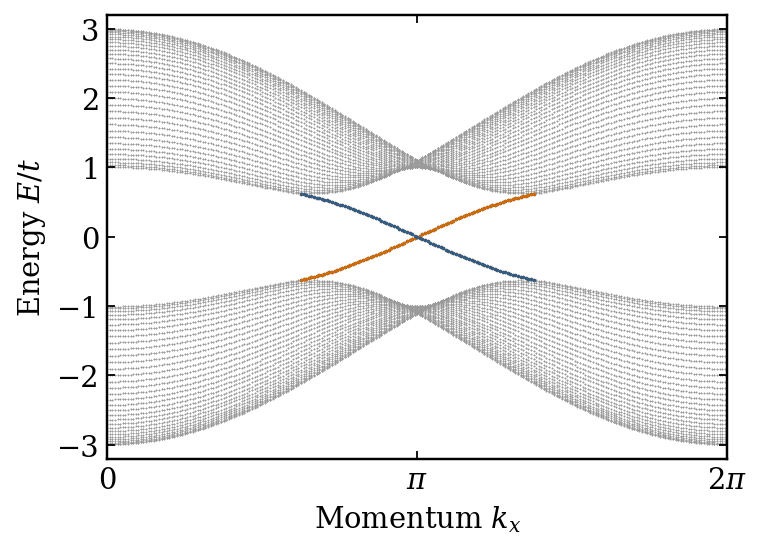
A topological insulator has an insulating interior and conducting states on its surface that cannot be removed without closing the bulk gap. The group predicted the quantum spin Hall effect in HgTe quantum wells, which was observed in experiment the following year. Later work introduced type-II Weyl semimetals, unconventional fermions in crystals and higher-order topological insulators.
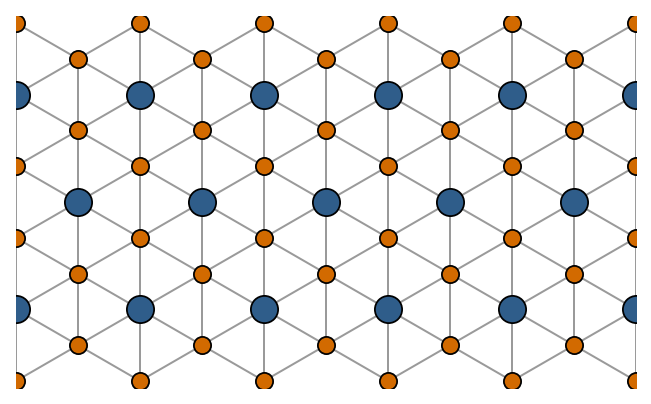
Topological quantum chemistry connects the band topology of a crystal to the orbitals of its atoms and the symmetry of its lattice. With collaborators in Donostia and Bilbao we applied the theory to tens of thousands of known compounds. The results are public in the group's materials databases.
Representative papers
- Quantum Spin Hall Effect and Topological Phase Transition in HgTe Quantum Wells
B. A. Bernevig, T. L. Hughes, S.-C. Zhang
Science 314, 1757 (2006) · arXiv - Topological quantum chemistry
B. Bradlyn, L. Elcoro, J. Cano, M. G. Vergniory, Z. Wang, C. Felser, M. I. Aroyo, B. A. Bernevig
Nature 547, 298 (2017) · arXiv - A complete catalogue of high-quality topological materials
M. G. Vergniory, L. Elcoro, C. Felser, N. Regnault, B. A. Bernevig, Z. Wang
Nature 566, 480 (2019) · arXiv - All Topological Bands of All Nonmagnetic Stoichiometric Materials
M. G. Vergniory, B. J. Wieder, L. Elcoro, S. S. P. Parkin, C. Felser, B. A. Bernevig, N. Regnault
Science 376, eabg9094 (2022) · arXiv
Machine learning for materials
We train machine-learning models on first-principles calculations and experimental databases to predict properties of crystals. Some models predict electronic and phonon densities of states and the electron-phonon coupling, and together they estimate a superconducting transition temperature from the crystal structure alone. Others classify magnetic order and predict Curie and Néel temperatures, recognize compounds that form with chemical disorder, or estimate melting points to guide synthesis. We also build generative models that propose new crystal structures. The goal is to narrow the search for new quantum materials before costly calculations or synthesis.
Publications coming soon.